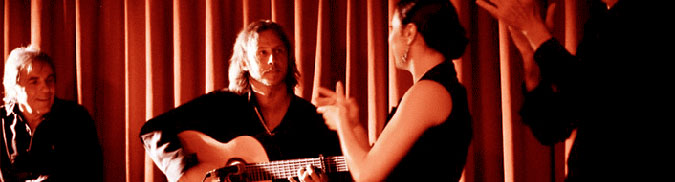
Damian Wright is the founder and leader of the flamenco ensemble Bandaluzia, who are performing at The Vanguard, Sydney on Thursday 29th July. Damian talks to us about the magic of flamenco, and his personal journey into this rich art form.
When did you first discover a passion for flamenco guitar?
Damian: Growing up in a musical family, I would often hear music from different cultures through my father’s interest in world music. I particularly connected to the musical scales of the Middle East, North Africa and India. From the age of 8 I began studies of the guitar with a mixture of rock, jazz and classical music and was more and more attracted to the melodies and harmonies of Spanish composers like De Falla and Albeniz. I then realised that their music was influenced by the flamenco music of southern Spain.
Around this time my parents took me to see a concert at the Sydney Opera House that celebrated gypsy music from India, the Middle East and Europe. I saw the flamenco guitarist Nino Josele perform and this was when I felt I had just witnessed what I felt to be one of the grandest and most expressive musical styles I had ever heard.
There seems to be an element of magic in flamenco, as embodied in the notion of duende. Can you explain a little what it is?
Damian: The poet Federico Garcia Lorca often referred to the term duende as “all that has sonidos negros (dark sound)”. Flamenco is an art form which can celebrate the darker side of human existence, acknowledging this and then expressing it into something sonically and visually powerful. The duende seems to refer to that moment in a great performance where the audience feels that the performer has conjured up something pure and universal that connects and causes the audience to react with emotion.
You have studied in Spain with some revered teachers. What is the most amazing thing you have learned or seen in relation to flamenco?
Damian: The most amazing thing I learned about flamenco is the depth and variety that the art form has, and to be humbled by it. Because flamenco is a folk music you can go to towns in Andalucia and learn motifs on the guitar from everyone - from the local barmen, or baker, to learning more indepth from maestros of the guitar. You can
learn about the cante (flamenco song) standing at a bar listening as someone sings and another marks time with their knuckles on a table. You can learn dance from a flamenco academy but also from a group of people giving palmas (hand claps) at the feria (town fair) or walking home at night seeing an impromtu ‘jam’.
There are many memorable moments but examples would be having a vino at a bar with my teacher, as the great dancer Joselito Romero “broke out” into a bulerias dance in front of me to explain the palmas and the swing of flamenco. Witnessing an impromtu performance of guitarist Juan Diego on my verandah in Jerez. Hearing 16 year old singer Canalita singing with his ‘tribe’ out the back of Damajuana bar in Jerez at 4am. Sitting in a circle in a tent at the Feria de Jerez with Capullo de Jerez, Gerado Nunez, Pepe Justicia, El Torta singing, dancing and jamming. And of course the countless number of great flamenco performances of artists like Tomatito, Vicente Amigo etc...
What is the relationship between the voice, palmas, dancer and guitars in a flamenco ensemble?
Damian: In a traditional ensemble, the guitar is solely an accompaniment to the singer and dancer, providing a kind of rhythmic harmony. The dancer may rise up to the stage as the singer begins the letra (verse) and the dancer will understand the cante (song) and reply and compliment the cante. The guitarist will provide rhythmic accompaniment to the dancer and the correct harmony to whatever the cantaor (flamenco singer)
chooses to sing. There are moments of rest for the singer and dancer and this is where the guitarist will enter with a falsetta (musical passage). Everyone in the ensemble has to understand the singing, dancing and guitar for the relationship to work.
Flamenco is celebrated as a high art these days, but it has very folk community origins. Can you give an insight into your thoughts on the form?
Damian: Flamenco is essentially a folk music that speaks for its people, their places and their experiences, however as an evolving art, flamenco has looked outside itself for sounds and colours that enrich the art form. Flamenco has been blessed with many great artists like Paco de Lucia, who have taken the art form to a level of musicianship and virtuosity that is at the highest level.
How did Bandaluzia come together?
Damian: The idea arose after many friends and colleagues over the years were urging me to create my own group. I recently realised I had a crew of people around me who loved flamenco and were great artists in their own right, whether as flamenco musicians or other, and I saw an opportunity to create something from this.
I wanted to create a group that I could use as a platform for my musical ideas and collaborate with musicians and dancers that I admired, or who were influenced by flamenco, whether based in Australia or traveling artists from Spain and abroad. I wanted an ensemble that could find it’s own sound.
Is all the music and dance choreography original or are there standards you perform as well?
Damian: The music and choreography are mostly original and that’s really important to Bandaluzia, to have it’s personal unique take on flamenco. Saying that, we always like to reference some of the traditional melodies and choreographies of the people who have influenced us along the way.
How do you approach original compositions in this style?
Damian: It’ll often happen in different ways. There are times when I’ll be seated with the guitar not consciously thinking of creating an idea, and there will be a trigger, such as a chord or a melody, rhythm or harmony which will take off with myself being almost like the observer in its creation. Other times I’ll consciously try and write a melody, which has a concept in mind and utilises set ideas and influences. To write in a flamenco style you must know the forms and their particular sentiments and rhythms.
What can we expect to see from the Vanguard show?
Damian: I’m really excited about this particular gig because it brings together some great examples of what Bandaluzia is about. The line up from the flamenco perspective is myself on guitars, Jessica Statham (dance) and Antonio Soria (singing), then we have the bass virtuoso Steve Hunter, Fabian Hevia (percussion) from Wanderlust, The Catholics fame and Shenzo Gregorio (Violin) known for is amazing work as a member of string quartet Fourplay. Expect to see a great variety of shades and influences in this show, virtuosity and the intensity this art form is loved for.
How do you see the flamenco form moving into the future? Would you consider yourself a purist or do you see value in mixing it up, as do groups such as Ojos de Brujo
Damian: I think of myself as a purist but only in the sense that for me what is pure is the intention. At the moment a musician plays a note or dancer conducts their first movement, if that comes from a state of honest and clear expression that transcends ego, that to me is pure. Therefore its not important if someone stays in the lines of tradition or travels to the experimental. It’s the ability to transmit and be a vehicle for that indescribable magic that we are moved by in music.
I think it’s great to fuse and mix whatever you feel into music, music is much more closely related to freedom than it is to restraints, and most of the people who hold past idols as solely having the keys to a tradition often fail to see that those they idolise were innovators in their day, accepting and nurturing their tradition but creating new exciting avenues.